Picture this: It is 11:00 PM. You stagger into your bedroom, bone-tired, looking to decompress from a relentless day. You flick the wall switch, only to be assaulted by an industrial-grade glare that feels less like a home and more like a surgical theater. That harsh, glaring illumination bounces off your neutral walls, triggering an immediate spike in cortisol when your nervous system desperately needs to power down. We have all lived through poor architectural lighting design—spaces that treat every room in the house like a high-output workspace, ignoring the fundamental psychological shifts required as day transitions into night.
The bedroom is an architectural anomaly. Unlike the kitchen, where uniform task lighting is non-negotiable for handling razor-sharp chef's knives, or the bathroom, where precise vanity illumination dictates your morning routine, the bedroom demands a nuanced duality. It must morph seamlessly from a bright, energizing dressing space in the early morning to a cocoon of profound relaxation by evening. Achieving this effortless equilibrium requires moving away from the lazy default of a single, central ceiling fixture and embracing a calculated strategy for recessed lighting.
When executed with precision, recessed lighting—often called downlighting or pot lighting—disappears into the architecture. It stops being a glaring mechanical apparatus and starts behaving like natural daylight filtering through structural apertures. Yet, the margin for error is razor-thin. Miscalculate your beam angles, place a can directly over the pillow zone, or specify the wrong color temperature, and you are left with an expensive, unfixable ceiling eyesore. Mastering this craft requires understanding the invisible mathematics of light layout, luminaire physics, and human circadian biology.
The Architecture of Rest: Why Traditional Bedroom Lighting Fails
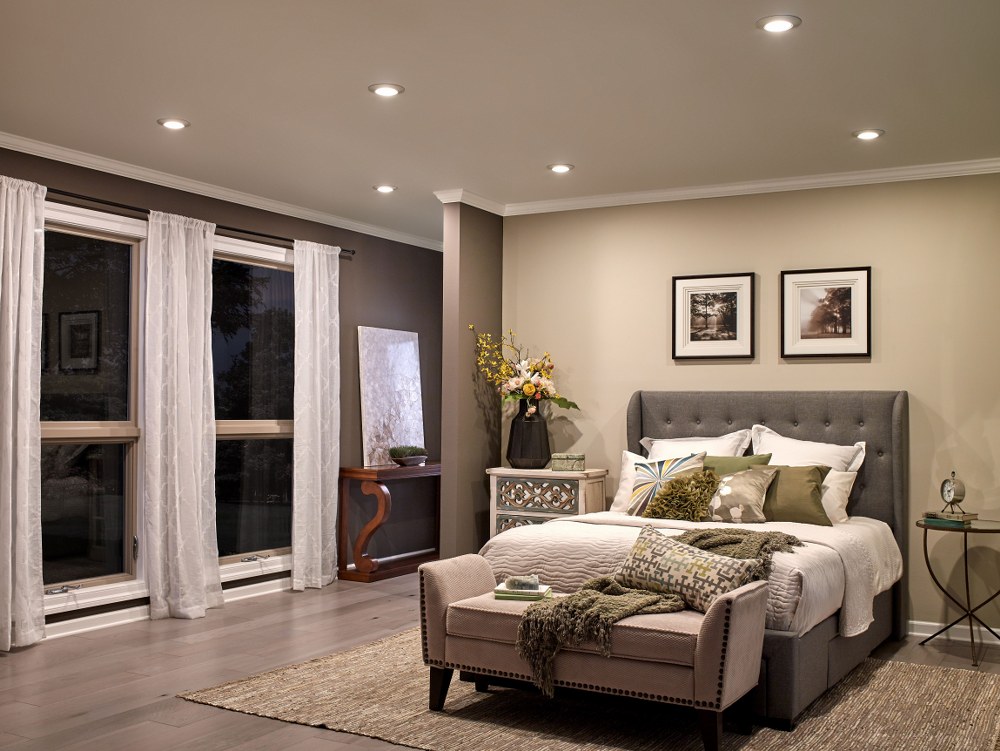
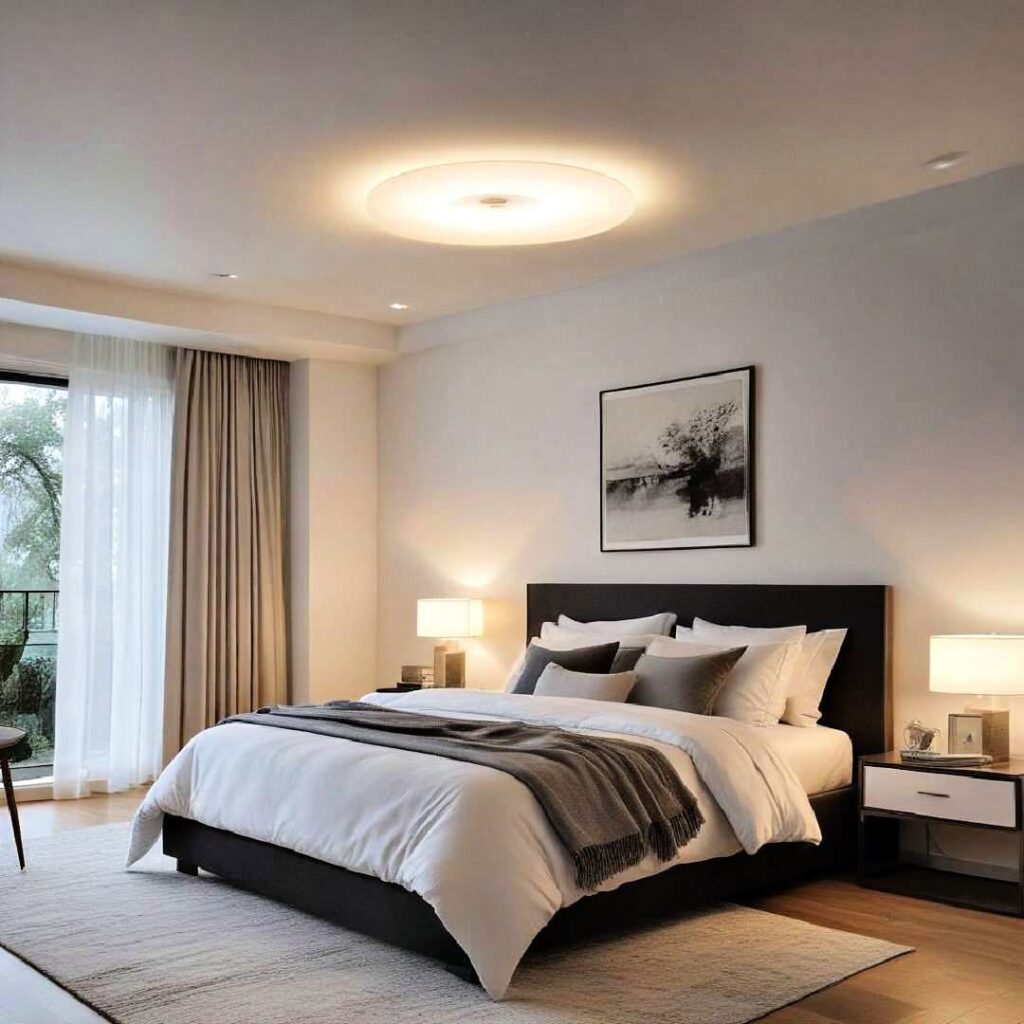
For decades, standard residential construction relied on the lazy shortcut of a single ceiling junction box centered dead-middle in the bedroom drywall. Screw in a flush-mount bowl fixture or a modest chandelier, and call it a day. This approach fundamentally misunderstands how human vision interacts with enclosed volumes. A central point source blasts maximum photons downward and outward, casting harsh shadows beneath furniture, highlighting ceiling imperfections, and bathing the room in flat, uninspired glare. When you lie down in bed, that central fixture often sits directly in your field of vision, forcing you to squint against bare or poorly diffused lamps.
Recessed lighting changes the spatial geometry entirely by distributing the luminous load across multiple discrete points. Instead of relying on one aggressive light engine, a well-planned layout divides the wattage across a grid of smaller apertures. This decentralization eliminates harsh hotspots and creates a balanced ambient wash that makes the entire room feel physically larger. Walls wash evenly, architectural textures pop with subtle depth, and the ceiling plane remains visually clean and unobstructed.
However, introducing downlights to a bedroom carries unique psychological traps. The primary mistake homeowners and amateur designers make is treating the bedroom like a commercial office space. They cram the ceiling with high-output cans spaced on a rigid, uniform grid, turning a private sanctuary into a retail showroom. Effective bedroom design demands restraint. The goal is not to illuminate the floor uniformly, but to create pools of gentle luminance that interact with vertical surfaces, textiles, and architectural volumes. When you understand that light reflects off your floors and walls just as much as it emits directly from the source, you stop fighting the room and start shaping its atmosphere.
Decoding the Physics of Layout and Spacing Formulas
Designing a professional recessed lighting grid is an exercise in applied geometry. You cannot simply eyeball pot lights onto a ceiling blueprint and hope for the best. Master electricians and lighting designers rely on tried-and-true mathematical formulas to determine fixture spacing, ensuring overlapping beam spreads that eliminate dark pockets without creating blinding pools of light. The golden rule of thumb for standard 8-foot ceilings dictates that fixtures should be spaced approximately 4 feet apart from one another and roughly 2 feet away from the walls.
For higher ceilings, such as 9-foot or vaulted spaces, the formula scales proportionally. A common professional guideline is to divide your ceiling height by two to determine the ideal distance between downlights. Therefore, in a room with a 10-foot ceiling, your fixtures should sit roughly 5 feet apart. Ignoring this ratio leads to chaotic spacing that disrupts the visual rhythm of the ceiling plane. Beyond raw spacing, you must factor in the diameter of the cans themselves. In modern residential design, the era of the bulky 6-inch can is rapidly fading, replaced by sleek, high-output 4-inch or even 2-inch apertures that deliver punchy illumination with minimal visual footprint.
Beam angles dictate how that light behaves once it exits the fixture. A narrow 25-degree spot beam acts like a theatrical spotlight, perfect for raking down a textured stone accent wall or highlighting a piece of art above the headboard. Conversely, a wide flood beam of 60 degrees or more disperses light broadly, making it ideal for general ambient washing across the center of the room. In a bedroom, you want to layer these angles intentionally. Never place a narrow beam directly over the mattress where an occupant might look straight up into the light engine; instead, push your ambient cans toward the perimeter and use adjustable gimbals or wall-wash trims to direct light where it actually serves a functional purpose.
Lumens, Color Temperature, and the Circadian Equation
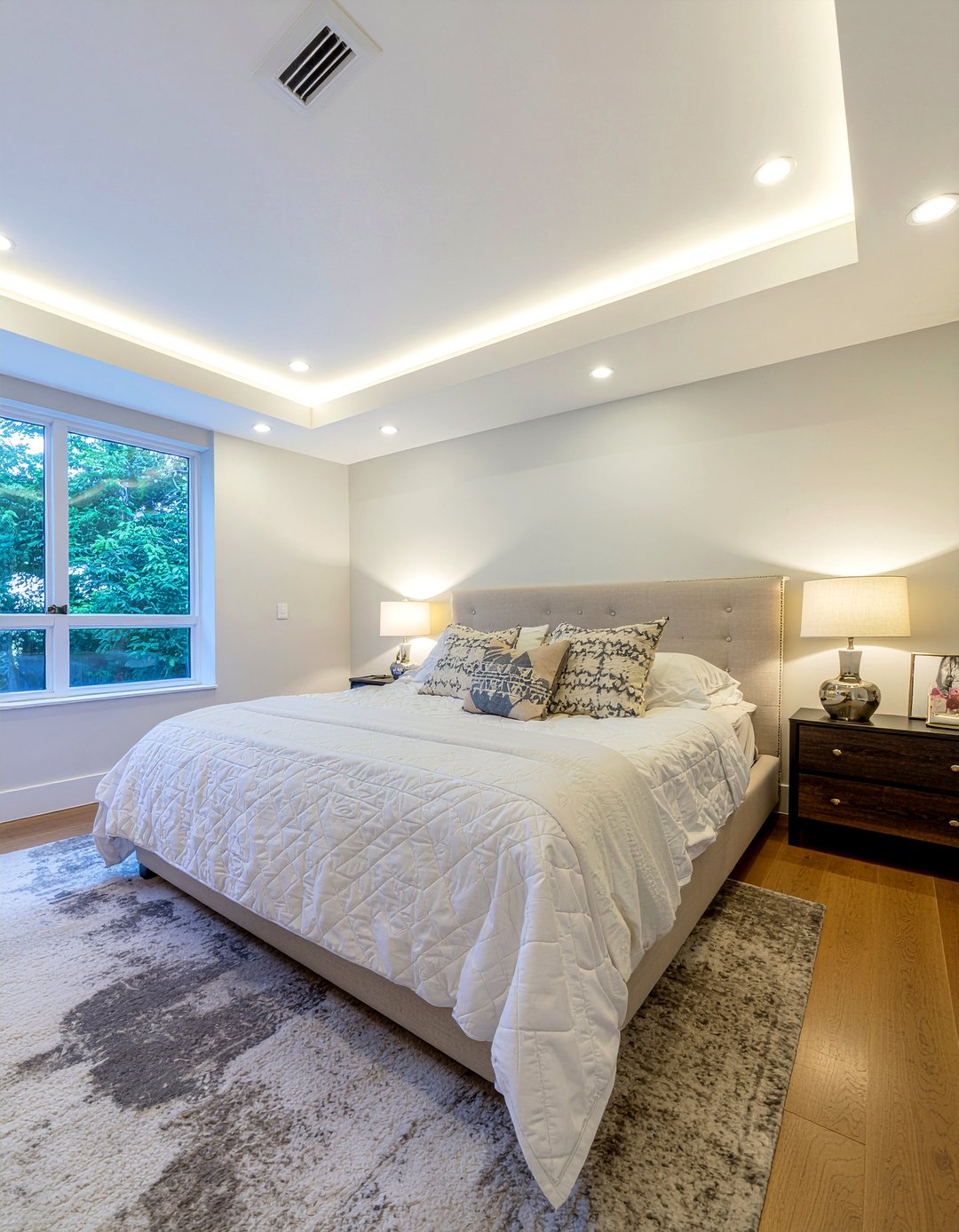
Walking into a lighting showroom can induce instant paralysis by analysis, especially when confronted with terminology like lumens, Kelvins, and CRI. When specifying recessed lighting for a bedroom, throw out the archaic notion of wattage. Wattage merely measures electrical power consumption; lumens measure actual luminous output. For a primary bedroom, your total ambient lighting calculation should aim for roughly 20 lumens per square foot. A standard 12x15 foot bedroom (180 square feet) requires roughly 3,600 total lumens. Crucially, this output should never be deployed at 100% capacity during evening hours. It represents your ceiling capacity, which will be heavily dialed down via dimmers.
Color temperature—measured on the Kelvin (K) scale—dictates the psychological warmth or coolness of the space. In a bedroom, anything above 3000K is an absolute non-starter. Cool white light mimics daylight, signaling the brain's suprachiasmatic nucleus to suppress melatonin production and stay alert. For a restful sanctuary, you should target a warm color temperature between 2400K and 2700K. Many modern integrated LED modules feature "warm-dim" technology, which mimics traditional incandescent bulbs by automatically shifting the color temperature down toward a cozy 2000K amber glow as you slide the dimmer switch lower.
Color Rendering Index (CRI) is the final technical frontier that separates amateur setups from professional masterpieces. CRI measures a light source's ability to faithfully reveal object colors compared to natural sunlight. Cheap, low-CRI LED downlights render skin tones sickly and drain the rich, tactile warmth out of your wooden furniture and organic bed linens. Insist on specifying recessed fixtures with a minimum CRI of 90, with 95+ being the gold standard. When your lighting achieves a high CRI, even a dark charcoal or deep navy bedroom wall reads with stunning depth and sophistication rather than flat, muddy gray.
Step-by-Step Implementation and Strategic Zoning
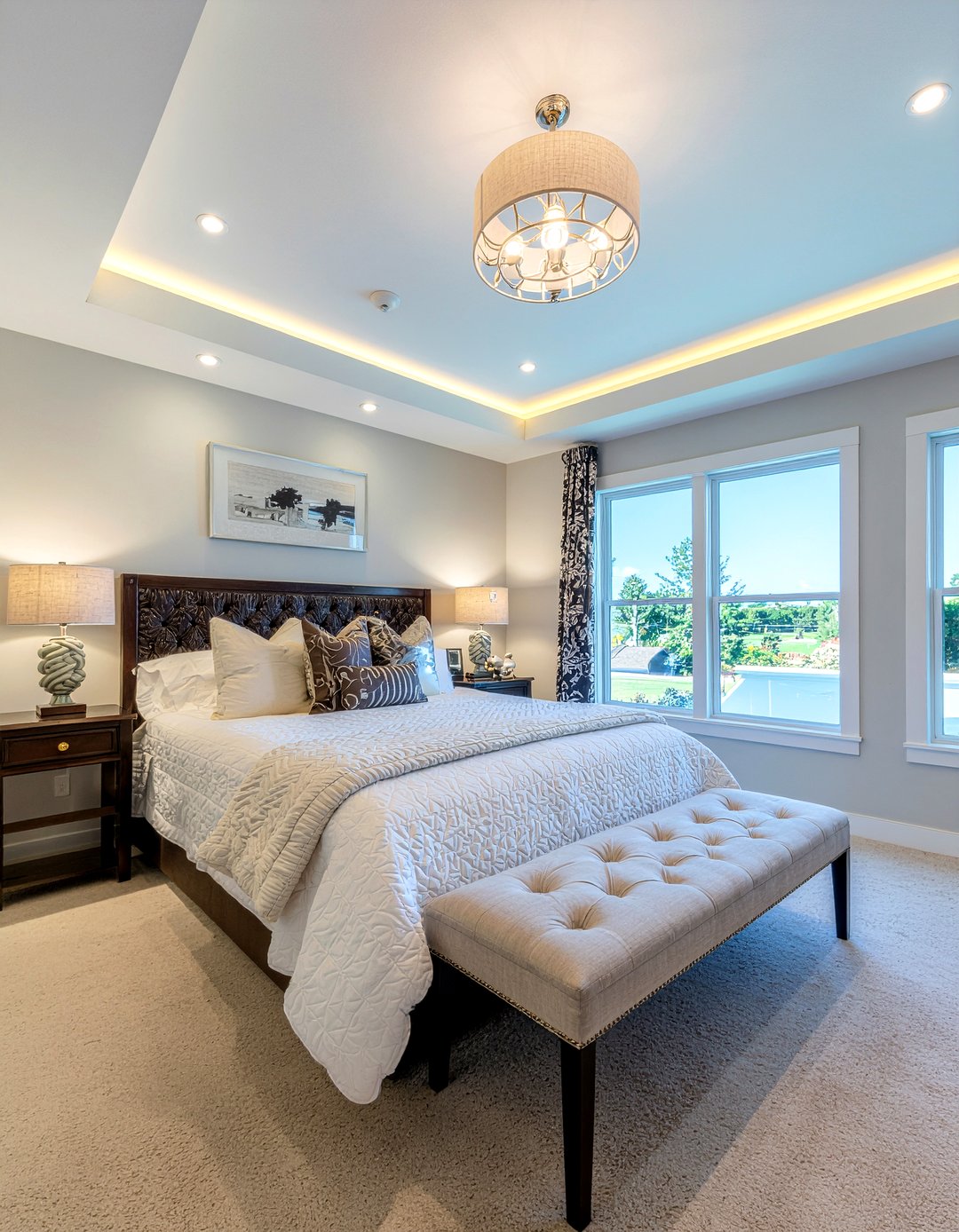
Transforming a raw bedroom ceiling into a masterpiece of layered illumination requires a methodical installation sequence. Whether you are retrofitting an existing space or wiring a new construction project, following a strict workflow prevents costly drywall patches and electrical rewiring nightmares.
Navigating Common Pitfalls and Field-Tested Workarounds
Even experienced contractors occasionally stumble when installing residential recessed lighting. Recognizing these recurring traps before they become permanent structural fixtures saves time, money, and aesthetic frustration.
The Broader Impact: Energy Efficiency and Circadian Health
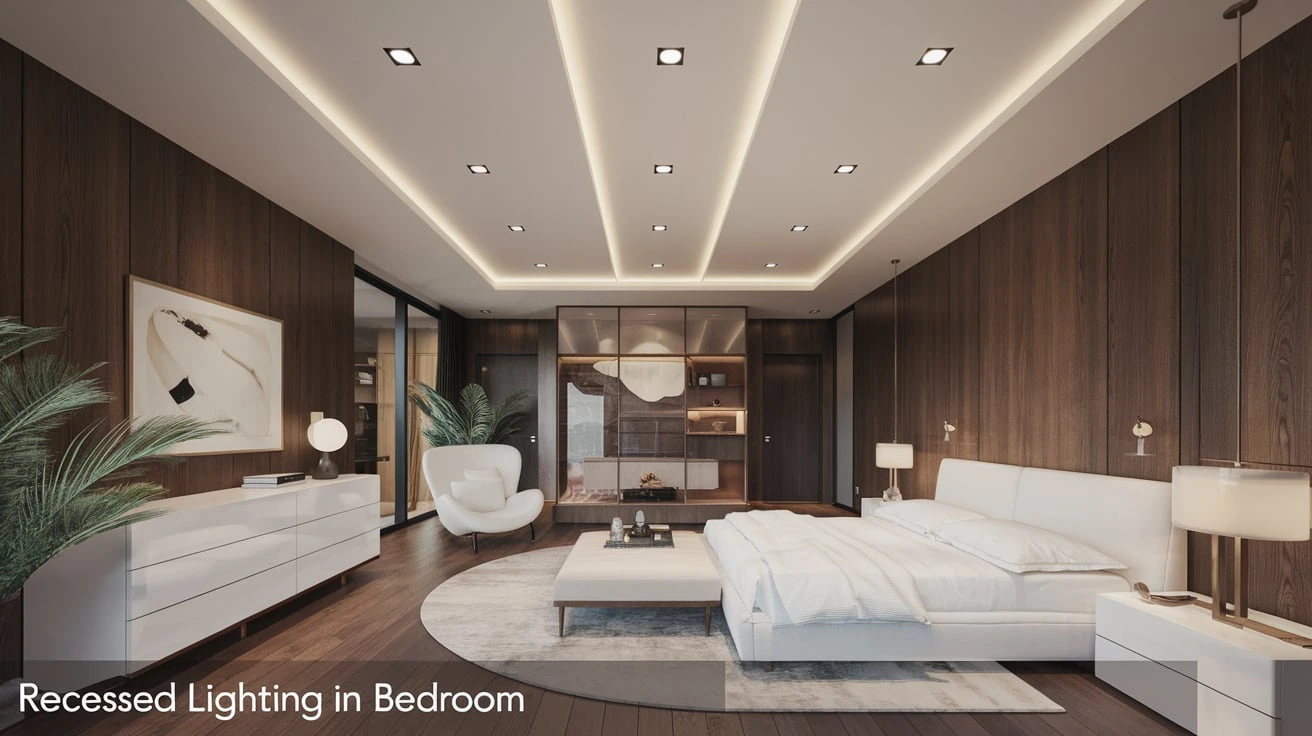
The conversation surrounding residential lighting has evolved far beyond simple aesthetics. In contemporary home design, lighting systems are increasingly recognized as critical infrastructure for human wellness and environmental stewardship. Transitioning away from archaic incandescent bulbs toward high-efficiency LED recessed architecture slashes residential energy consumption by up to 80 percent. When integrated with smart home automation platforms, bedroom lighting can be programmed to dynamically shift its color temperature and intensity throughout the day, automatically ramping up to a crisp 3500K in the morning to assist waking, and slowly descending into a deep, amber 2200K as bedtime approaches.
This biological synchronization aligns modern interior architecture with our evolutionary biology. Artificial light at night (ALAN) is a documented disruptor of human circadian rhythms, linked in numerous clinical studies to chronic sleep deprivation, metabolic disruption, and suppressed immune function. By designing a bedroom recessed lighting system that prioritizes deep dimming capabilities, warm spectral outputs, and indirect wall-washing techniques, you actively engineer an environment that protects your neurological health. The fixture in the ceiling ceases to be a mere utility; it becomes an active participant in your nightly restoration.
Furthermore, the economic durability of modern integrated LED fixtures alters the calculus of home maintenance. Traditional incandescent or halogen pot lights required constant ladder acrobatics to replace burned-out bulbs every few thousand hours. High-end architectural LED modules boast operational lifespans exceeding 50,000 hours—translating to decades of maintenance-free performance under normal residential use. This longevity, paired with falling manufacturing costs for high-CRI, smart-enabled diodes, ensures that investing time and precision into a master bedroom lighting layout pays dividends in both daily comfort and long-term property value.
Designing the ultimate bedroom lighting scheme is ultimately an exercise in disciplined editing. The most successful spaces do not overwhelm the eye with flashing options or blinding brightness; they whisper. They provide the exact quantum of light required for the task at hand, whether that is folding laundry on the duvet, reading a novel before sleep, or navigating safely to the bathroom in the middle of the night without waking a partner. By approaching your ceiling layout with mathematical precision, selecting warm, high-CRI luminaires, and respecting the psychological boundaries of a private sanctuary, you elevate the bedroom from a purely utilitarian box into a restorative architectural masterpiece.
Embrace the power of restraint. Let your walls and floors do the heavy lifting by bouncing soft, indirect illumination throughout the volume of the room. Demand quality from your hardware, ensuring that every dimmer, driver, and trim ring works in silent harmony to banish harsh glare. When you step into your newly designed bedroom at the end of a grueling day, the transformation will be unmistakable. The harsh edges of reality dissolve at the door, replaced by an atmosphere meticulously engineered for peace, rest, and profound human comfort.